
You wash your car on a Sunday morning, step back to admire the clean paint, and instead see a web of fine scratches spiraling across every panel. That’s not leftover dirt. Those are swirl marks and micro-abrasions sitting inside your clear coat, and no amount of rinsing will make them disappear. A standard car wash puts them there. If you want to remove them for good, a professional car paint polishing service levels the clear coat with abrasive compounds and machine tooling, eliminating the defects that scatter light and kill gloss.
This guide covers exactly how the process works, what each service level realistically delivers, what it costs in 2026, and how to evaluate any detailer before you hand over your keys. Mobile services like Auto Detail Now have also made professional-grade paint restoration accessible without requiring a shop drop-off, which changes the calculus for a lot of busy car owners.
What a professional car paint polishing service actually does to your paint
A machine polish is not a wax. Wax sits on top of the paint and fills in light imperfections temporarily. A professional polish physically removes a micro-thin layer of clear coat to level the surface, cutting away the damaged material so what remains is smooth, even, and reflective. Understanding that distinction explains why prep work matters as much as the polishing itself.
The surface prep that comes before any machine touches the paint
Before a polisher is plugged in, a quality technician runs the car through a full decontamination sequence: a thorough wash to remove loose debris, followed by an iron remover sprayed panel by panel and left to dwell for two to five minutes before rinsing. Iron particles from brake dust and road grime embed into paint and are invisible to the eye, but polishing over them grinds those particles across the surface and creates fresh defects. After the iron remover rinses clean, a clay bar treatment pulls bonded contamination that survived the chemical step. The whole process takes thirty to sixty minutes and happens before the machine comes out. Skipping it is how cheap jobs damage paint instead of fixing it.
The tools professionals use: DA polisher vs. rotary buffer
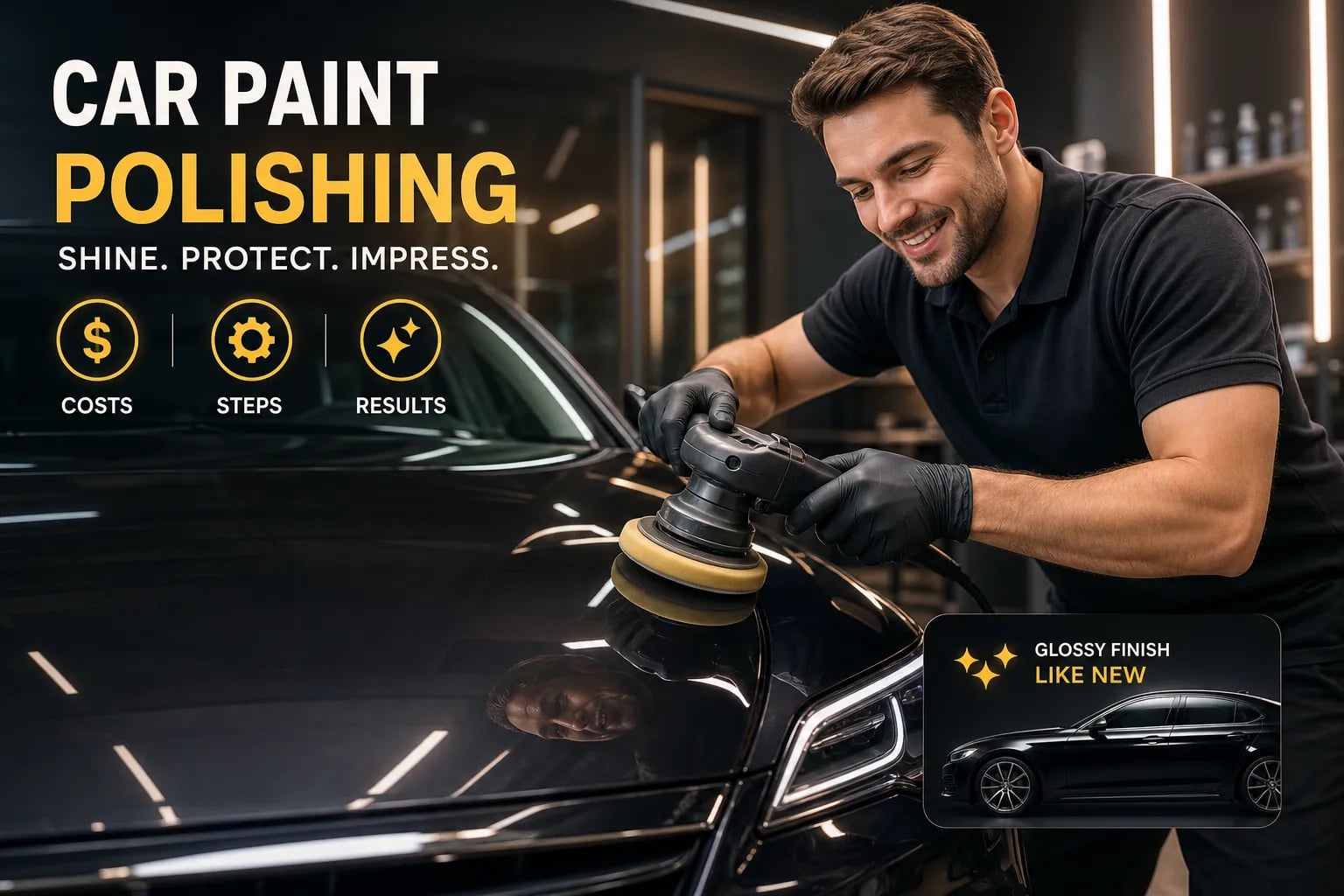
Two machine types dominate professional paint correction work. A dual-action orbital polisher combines rotation and oscillation, spreading heat across a wider area and making it far harder to burn through thin clear coat. It cuts more slowly, which makes it the right tool for daily drivers, lighter correction work, and technicians who prioritize safety margins. A rotary buffer spins on a fixed single axis, generating more heat and cutting significantly faster, making it effective for heavy oxidation and deep defect work in the hands of an experienced operator. Pad type matters as much as machine type: cutting pads and microfiber pads pair with heavier compounds for aggressive correction, while softer foam polishing and finishing pads pair with finer products to refine the surface. The combination of machine, pad, and compound determines how aggressively the technician is cutting into your clear coat.
Compounds vs. polishes: why the product choice matters
Cutting compounds are the most abrasive products in the lineup. They remove paint faster and target deeper defects like oxidation and heavy marring. Polishes use finer abrasives to refine the surface after compounding, removing the haze left by heavier work and restoring gloss and clarity.
Finishing products sit at near-zero abrasion and are used as a final pass to maximize reflectivity. A one-step service uses a product engineered to correct and finish in a single pass. A multi-step correction runs through the full sequence, cut, polish, and finish, with each stage targeting what the previous one left behind.
1-step, 2-step, and multi-stage polishing: what each one targets
Service levels exist because not every car has the same paint condition, and using a more aggressive correction process than the paint needs wastes money and removes unnecessary clear coat. Matching the service to the actual damage state is the most important decision in any paint correction job.
1-step enhancement: the right call for lightly marred paint
A single-stage polish uses one balanced compound and pad combination to correct and finish in a single pass. It’s effective for light swirl marks, minor haze, fine scratches, and light oxidation. Based on typical correction outcomes, customers can expect roughly fifty to seventy percent of visible surface defects removed at this level. The job typically takes two to four hours and sits at the most affordable end of the pricing range. This isn’t a compromise service, it’s simply the right tool when paint doesn’t need heavy correction. Applying a more aggressive process to lightly marred paint removes clear coat the car doesn’t need to lose.
2-step correction: where the visible transformation happens
Two-stage paint correction separates the compounding phase from the polishing phase. The first pass targets deeper swirl marks, oxidation, water spot etching, and heavier marring. The second pass removes the haze left by the compound and restores gloss and optical clarity. Customers can expect seventy to ninety percent or more of defects removed at this level, and the before-and-after difference is dramatic on cars with visibly damaged or dull paint. The job runs five to eight hours because of the additional labor, and the price reflects that. Most car owners with noticeably tired or scratched paint need this level of service, not more and not less.
Multi-stage correction: maximum results for the most demanding jobs
Three or more stages are reserved for heavy oxidation, significant marring, or situations where the owner wants as close to perfection as the paint’s condition safely allows. After compounding and polishing, a jeweling or finishing stage addresses micro-marring left by earlier steps and pushes the surface toward maximum clarity. Time runs eight to sixteen hours or more. Every stage removes a thin layer of clear coat, so a paint thickness gauge reading should be part of the pre-inspection on any multi-stage job. A qualified technician will check the numbers, tell you how much working room the paint has, and stop before reaching the danger zone. If a detailer skips that step, that’s reason enough to find someone else.
Expected results from a car paint polishing service
Honest expectations protect you from two directions: detailers who overpromise and say they can fix everything, and the frustration of paying for a swirl removal service and not understanding why one specific scratch is still visible.
Swirl marks, oxidation, and scratch removal by service level
A one-step polish removes roughly fifty to seventy percent of light surface defects. A two-step correction targets seventy to ninety percent of defects, with experienced technicians pushing toward ninety percent or beyond when paint thickness and condition allow. Multi-stage correction pushes toward ninety to ninety-five percent when the clear coat has enough depth to work with. These percentages apply to surface-level defects: swirl marks, light scratches, water spot etching, and oxidation sitting within the clear coat. Random deep scratches that have cut through the clear coat into the base coat cannot be polished out. Polishing works by leveling the surface around them, not filling them in.
What polishing cannot fix (and why that’s worth knowing before you book)
Deep key scratches, rock chips, paint cracking, and rust are outside the scope of any polishing service. A professional technician will identify those during the pre-inspection and tell you upfront what correction can and cannot address, rather than polishing around the problem and billing full price for partial results. If a detailer doesn’t discuss limitations before starting the job, that tells you something about how they operate. The pre-inspection conversation is part of the service, not a formality.
What a car paint polishing service costs in 2026
Prices vary by vehicle size, paint condition, and correction level. The ranges below reflect professional service in 2026, not dealership paint protection add-ons or single-step machine buffing at a quick-lube shop.
Price ranges by vehicle size and correction level
For compact cars and sedans, a one-step polish runs roughly $200 to $400, and a two-step correction typically lands between $400 and $700. SUVs cost more because of the additional surface area: expect $275 to $500 for a one-step and $500 to $900 for a two-step correction. Luxury vehicles start at $300 to $600 for a one-step service, with multi-stage correction commonly running $600 to $1,200 and up. Show-car level or heavy restoration work on premium paint can reach $2,500 or more. Those aren’t outlier prices for the quality of work involved, they reflect sixteen or more hours of skilled labor on a demanding car paint polishing service.
What makes a quote go higher or lower
Paint condition is the biggest variable. Heavier defects require more aggressive compounding, more stages, and more hours, all of which push the price up. Vehicle size is straightforward: more surface area equals more time.
Paint type matters too. Soft European paint cuts easily but requires more care to avoid holograms, while harder Japanese paint takes more effort to correct. Dark colors reveal every micro-scratch after correction, demanding additional finishing passes to achieve an acceptable result. Finally, check whether decontamination is included in the quoted price or billed separately. Some detailers bundle the clay bar prep; others list it as an add-on. Know what you’re comparing before you evaluate competing quotes.
Protecting the finish after polishing: wax, sealant, and ceramic coating
A fresh correction is the best possible surface to apply protection to. The clear coat is smooth, clean, and open. What you put on top of it determines how long that corrected finish stays that way.
Wax and paint sealant for short-term coverage
Carnauba wax is the traditional option: it adds gloss and provides light protection against UV and contamination, but it typically breaks down within one to three months from washing and sun exposure. Synthetic paint sealants are polymer-based and bond slightly harder than carnauba, offering three to twelve months of coverage depending on the product and conditions. Both are reasonable short-term choices, particularly for owners who detail frequently and don’t mind reapplying protection on a regular schedule. Neither one seals the corrected surface against contamination the way a harder coating does, and neither protects the investment the way a longer-term option would.
Ceramic coating as the long-term follow-up to paint correction
Ceramic coating bonds chemically to the clear coat and creates a semi-permanent layer that resists UV exposure, water, light scratches, and surface contamination. Lifespan ranges from one year for entry-level consumer products to seven or more years for professional-grade multi-layer systems. When applied directly after a full paint correction, ceramic coating locks in the corrected finish, meaning the owner doesn’t have to repeat the correction process as frequently. Entry-level professional ceramic coating installations start in the $300 to $500 range for coating alone. Professional-grade packages with multi-layer systems often run $1,000 to $2,000 or more when applied on top of a full correction. The math is straightforward: if you’ve already paid for correction, protecting that result with a coating that lasts years costs less over time than re-correcting paint that was left unprotected.
Why mobile paint polishing deserves serious consideration
With a clear picture of what professional correction costs and what it protects, it’s worth addressing where you get it done. There’s a persistent assumption that mobile detailing is a convenience trade-off, that you give up quality in exchange for not driving to a shop. That assumption is wrong. A well-equipped mobile detailer brings the same dual-action polishers, compound systems, paint thickness gauges, and lighting rigs to your driveway that a fixed bay uses. The work takes the same number of hours. The products are identical. The difference is that it happens where your car already sits, and you don’t lose half a day coordinating drop-off and pickup.
Auto Detail Now operates exactly this way across San Diego: the same professional-grade correction process, the same ceramic coating options with lifetime warranty coverage, delivered to your driveway or workplace. With over 115 five-star Google reviews built on years of consistent results, and a 48-hour rain guarantee that brings them back to rewash at no charge if rain falls within two days of your service, it’s a straightforward choice for San Diego car owners who want professional work without the hassle.
Five questions to ask any detailer before you confirm a booking
These questions aren’t meant to test the detailer, they’re meant to give you a clear picture of who you’re working with before the machine touches your paint:
- Do you use a paint thickness gauge before starting, and will you share the readings with me?
- Is the clay bar decontamination included in the quoted price or billed separately?
- What compound and machine setup do you use for this correction level?
- What percentage of defect removal should I realistically expect given my paint’s condition?
- What protection option do you recommend after polishing, and why?
A detailer who answers those questions directly, without hesitation or vague reassurances, has done this work enough times to be trusted with your paint. Evasive or overly promotional answers to any of them are worth taking seriously before you commit.
The decision is simpler than it looks
Match your paint’s condition to the right service level. Light swirl marks and minor haze call for a one-step enhancement. Visible marring, oxidation, and scratched paint call for a two-step correction. Heavy damage or perfection-level work calls for multi-stage correction with a paint thickness check at every stage. Understand what the price reflects, ask the right questions, and the decision becomes straightforward.
A quality car detailing paint polish doesn’t just improve how your car looks this weekend. It removes the damage that accelerates paint aging and sets the surface up for protection through a sealant or ceramic coating that keeps it looking corrected for years. The investment makes sense when you understand what you’re actually paying for.
If you’re in San Diego and want professional paint correction without the shop drop-off, choosing the right car paint polishing service makes all the difference, and Auto Detail Now brings the full process to your location, backed by a lifetime ceramic coating warranty and a 48-hour rain rewash guarantee. Get a quote or book a service directly at Auto Detail Now and keep your car looking the way it should.
