
Watch rain hit a freshly coated hood and the effect stops you mid-thought. Water doesn’t spread. It pulls itself into tight, rounded beads, rolls across the panel, and carries dust and pollen with it, leaving the paint underneath clean and untouched. That’s a hydrophobic car coating doing exactly what it was engineered to do. The science behind it is real, and when the coating is applied correctly, the results are consistent.
What’s not consistent is the performance gap between coating types. A $25 spray from the auto parts store and a professional nano-ceramic system both bead water. They don’t both do it for the same amount of time, and they don’t both protect the paint underneath at the same level. After 15-plus years in mobile detailing with Auto Detail Now, our team has seen firsthand how dramatically surface prep and coating quality change real-world results. This article breaks down the science, the coating options, and how to match the right hydrophobic car coating to your specific situation.
The science behind how a hydrophobic car coating makes water bead
How surface energy controls the way water behaves on paint
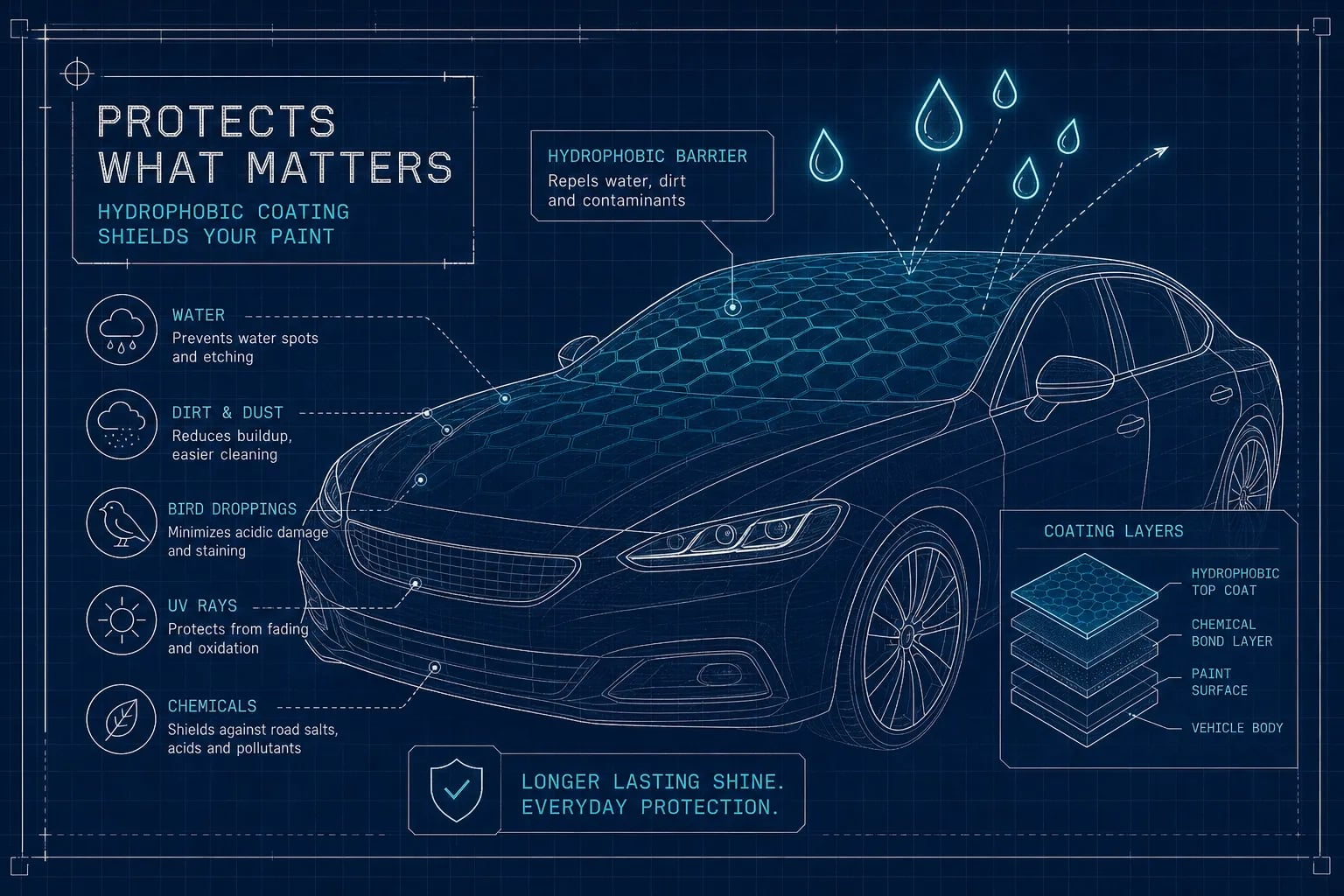
Surface energy is the key concept, and it’s simpler than it sounds. When a car’s bare clear coat sits exposed, it has relatively high surface energy, which means water spreads out and wets the surface rather than pulling away from it. That flat film of water is exactly what leaves mineral deposits and contamination behind when it dries. A hydrophobic car coating lowers that surface energy, forcing water to contract inward and form droplets instead of spreading into a thin sheet.
The coating creates a microscopic barrier with a textured nano-structure: tiny peaks that trap air between the droplet and the paint. Water sits on top of those peaks rather than seeping into the texture of the clear coat. The result is a droplet that has very little contact with the actual surface, making it far easier for gravity and airflow to move it off the panel entirely.
What the water contact angle actually measures
The water contact angle is the standard measurement for how hydrophobic a surface is. At 90 degrees, a surface is considered hydrophobic. High-performance nano-ceramic and graphene coatings push that angle above 110 to 120 degrees in real-world conditions. Gtechniq’s EXO, for example, consistently measures around 114 to 115 degrees in their published data. The higher the angle, the tighter the droplet, and the faster it sheds off the panel under normal driving speeds or light rainfall.
This isn’t just a lab number. A higher contact angle directly translates to less time water sits on your paint, which means fewer mineral deposits, less contamination bonding to the surface, and a dramatically cleaner finish between washes.
The self-cleaning effect and what it means for day-to-day maintenance
How water rolls off and takes contamination with it
High contact angle means tight droplets. Tight droplets mean the water rolls rather than sits. As a bead moves across the panel, it picks up loose contaminants: road dust, pollen, light grime, unbonded bird dropping residue. This is the self-cleaning mechanism, and it’s one of the most practical benefits for daily drivers. It doesn’t eliminate washing, but it meaningfully reduces how much contamination sticks to the surface between washes.
The difference shows up most clearly after a light rain or morning dew. On an uncoated car, that moisture leaves a thin film that dries into a hazy, contaminated layer. On a properly coated panel, the water rolls off, and the surface looks almost as clean as it did before the moisture hit it.
How a hydrophobic car coating reduces maintenance time
Because contamination has a harder time bonding to a low-surface-energy coating, wash days become faster and physically easier. A two-bucket wash lifts grime without heavy scrubbing, and the paint stays slick and smooth to the touch for longer. Water spotting from mineral deposits becomes far less frequent because water doesn’t sit long enough to deposit those minerals in the first place.
For busy car owners, this practical time savings often matters as much as the long-term paint protection. A wash that used to take 45 minutes gets done in 20. The paint looks better longer with less effort. That’s the daily value of a quality hydrophobic coating working the way it should.
Hydrophobic car coating types compared: spray sealants, liquid ceramic, and professional-grade systems
Spray sealants and consumer ceramic sprays
Spray-type hydrophobic products, including SiO2 boost sprays and consumer-grade liquid glass car coating formulas, are the accessible starting point. They’re easy to apply, cost between $20 and $100 at retail, and deliver real water-beading performance from day one. The trade-off is durability: most spray sealants last three to six months, and even premium consumer ceramic sprays rarely hold their hydrophobic performance past six to twelve months before noticeable degradation sets in.
These products are a legitimate choice for a daily driver when the goal is a refreshed layer of protection every few months. Set realistic expectations going in, plan to reapply when beading performance drops, and the cost stays low enough that the cycle makes sense.
Professional ceramic and graphene coatings
Professional-grade ceramic coatings, applied after thorough paint correction and decontamination, typically last two to five years. High-end nano-ceramic systems installed by a certified detailer can reach five to seven years with proper aftercare. Graphene coating formulations advertise similar longevity, though independent real-world testing suggests quality SiO2 ceramic systems often match or outperform graphene in long-term durability. Much of what’s labeled “graphene” in consumer products is still fundamentally a ceramic coating with a graphene additive; the prep quality and base chemistry matter more than the label.
Professional service costs range from $700 to $2,500+ depending on vehicle size, paint condition, and the level of paint correction required before coating. The durability gap between consumer sprays and professional coatings isn’t subtle. It’s measured in years versus months, and that gap is why vehicle owners with any significant investment in their paint make the switch.
Long-term paint protection beyond the beading effect
UV oxidation, chemical fallout, and clear coat degradation
Water beading is the visible benefit, but the coating’s low-surface-energy barrier also slows UV oxidation, resists acidic fallout from bird droppings and industrial contamination, and reduces the rate at which the clear coat degrades. San Diego’s year-round coastal sun creates one of the harshest environments for automotive paint in the country. UV radiation breaks down polymer bonds in the clear coat, salt air deposits hygroscopic particles that hold moisture against the surface, and ocean reflection adds UV load that inland vehicles never experience.
Unprotected clear coat near the coast can fail in two to three years; in milder northern climates, the same paint might last seven to ten. A properly bonded nano-ceramic coating acts as a sacrificial layer that absorbs that environmental punishment instead of the clear coat. The coating degrades slowly over time while the paint underneath stays protected and intact.
Resale value and long-term paint integrity
A car with deep, glossy, preserved paint sells for more and sells faster. Ceramic coatings keep color depth consistent, prevent micro-marring from light surface contact, and reduce the need for aggressive paint correction down the road. For owners of luxury vehicles, Teslas, collector cars, or any vehicle they plan to hold for more than three years, that protection compresses long-term maintenance costs significantly. Skipping one paint correction job because the paint never needed it pays for a substantial portion of the original coating investment.
Why surface prep determines whether the coating actually bonds
The steps most DIY applicators skip
A hydrophobic car coating can only bond to a clean, contamination-free surface. Skipping clay bar decontamination leaves iron particles and bonded fallout embedded in the clear coat, which prevents an even chemical bond across the panel. Skipping an IPA panel wipe after polishing means residual polishing oils block adhesion at the molecular level. A coating applied over contamination or oil residue will peel, streak, or lose hydrophobic performance within weeks rather than months.
The correct prep sequence is: thorough wash, chemical iron decontamination, mechanical clay bar decontamination, paint correction where needed, then a final IPA or dedicated surface prep wipe immediately before coating application. Each step exists for a specific reason. Cutting any of them doesn’t save time; it guarantees early failure.
How Auto Detail Now ensures proper bond strength on-site
This is exactly where professional mobile detailing changes the outcome. Auto Detail Now’s certified technicians complete full decontamination, paint correction where needed, and panel prep before any coating touches the surface, all at the customer’s home, office, or wherever the vehicle is parked. There’s no drop-off, no guessing about what prep steps were skipped, and no shortcuts taken because the shop is busy. The coating cures under controlled conditions and bonds the way the manufacturer intends.
For a treatment that’s meant to last years, getting the application right the first time isn’t optional. It’s the whole investment. A coating applied over contaminated or oily paint may bead water on day one and fail by month three. A coating applied over a properly prepped surface performs consistently for years.
Cost, lifespan, and choosing between DIY and professional application
When a consumer spray is the right call
If the goal is a fresh layer of water-repellent protection every few months on a daily driver, consumer SiO2 spray sealants and hydrophobic coating for cars in spray form are a practical and affordable choice. They work, they’re forgiving to apply, and the $20 to $100 price point makes reapplication easy to absorb. Apply in the shade to a clean, decontaminated surface, work in small two-by-two-foot sections, use less product than you think you need, and follow the cure window without exposing the car to moisture. Done correctly, a consumer spray delivers real beading performance for three to six months.
When professional application makes the most financial sense
For any vehicle with more than casual value, including luxury cars, Teslas, collector vehicles, or any car in San Diego’s coastal UV and salt air environment, professional ceramic coating pays for itself in preserved paint and reduced long-term maintenance costs. The $700 to $2,500+ investment buys years of protection, not months, and the correct prep work ensures the coating performs as warranted rather than failing quietly six months after application.
Auto Detail Now backs every job with a 48-hour rain guarantee and a track record of 115-plus five-star reviews. That removes the uncertainty that comes with a DIY coating applied over inadequate prep. If you’re ready to move from spray sealants to a professional-grade system, reaching out to the Auto Detail Now team is the straightforward next step. The coating comes to your location, the prep is done right, and the protection lasts.
Frequently asked questions about hydrophobic car coatings
How long does a hydrophobic car coating last?
It depends on the product type and application quality. Consumer spray sealants and SiO2 boost sprays typically last three to six months. Premium consumer ceramic sprays can hold hydrophobic performance for six to twelve months. Professional-grade nano-ceramic coatings applied over properly prepped paint generally last two to five years, and high-end systems installed by a certified detailer can reach five to seven years with regular maintenance washes.
Can I apply a hydrophobic car coating myself?
Consumer spray products are designed for DIY use and are forgiving enough that most car owners can apply them successfully. Professional ceramic and graphene coatings are a different category. They require multi-step decontamination, paint correction, and an IPA wipe-down before application. Skipping any of those steps compromises the bond and shortens the coating’s lifespan significantly. For a long-term investment coating, professional application is worth the cost.
Does a hydrophobic coating protect against scratches?
A properly bonded nano-ceramic coating adds measurable hardness to the paint surface, which reduces micro-marring from light contact. It is not a scratch-proof layer. Deep scratches from keys or aggressive abrasives will still penetrate. The primary protection is against UV oxidation, chemical fallout, water spotting, and contamination bonding, not physical impact damage.
Do I need to do anything special to maintain a coated car?
Coated paint is significantly easier to maintain than uncoated paint, but it still needs regular washing. Use a pH-neutral soap, avoid automatic brush washes, and dry the car with a clean microfiber towel after washing. Applying a ceramic spray booster every three to four months helps maintain peak hydrophobic performance. Avoid parking under trees for extended periods, as fresh tree sap and bird droppings should be removed promptly before they etch through the coating.
The right coating starts with the right foundation
The core logic holds across every product on the market: a hydrophobic car coating works by lowering the surface energy of the paint so water beads, rolls, and carries contamination with it. The physics are consistent. What differs is how long each coating type maintains that performance and how well it bonds based on the prep work underneath it.
Consumer sprays are a solid short-term solution for drivers who want convenience and affordability. Professional ceramic and graphene coatings are a long-term investment in the paint itself, one that pays off in preserved resale value, fewer maintenance hours, and real protection against San Diego’s coastal environment. The coating category and the application quality need to match the goal.
If you want protection that holds up under real driving conditions and real weather, get in touch with the Auto Detail Now team. The consultation is straightforward, the service comes to you, and the prep is done the way it needs to be done, so the coating actually lasts.
