
You pull out of the driveway on a Tuesday morning, merge onto the highway, and by the time you reach your exit, your hood has two fresh rock chips and a bird dropping baking into the clear coat in the rearview mirror. That’s not bad luck. That’s what happens to unprotected paint in daily driving conditions, and it happens faster than most people expect. Paint protection isn’t a luxury add-on, it’s the most practical decision you can make for a vehicle you plan to keep looking sharp.
The good news is that paint protection has evolved well beyond a coat of wax applied on a Saturday afternoon. You now have real options: from budget-friendly sealants to highly impact-resistant paint protection film (PPF). The challenge is that each option works through a completely different mechanism, costs differently, and fits different lifestyles. What makes sense for a daily commuter in San Diego isn’t the same as what a Tesla owner or a weekend exotic driver needs. At Auto Detail Now, our team has spent years applying every major protection solution across passenger cars, luxury vehicles, and exotics, and that hands-on experience shaped everything in this guide.
Here’s a straightforward breakdown of the four main protection options, what they actually do, what they cost, and how to pick the right one for your situation.
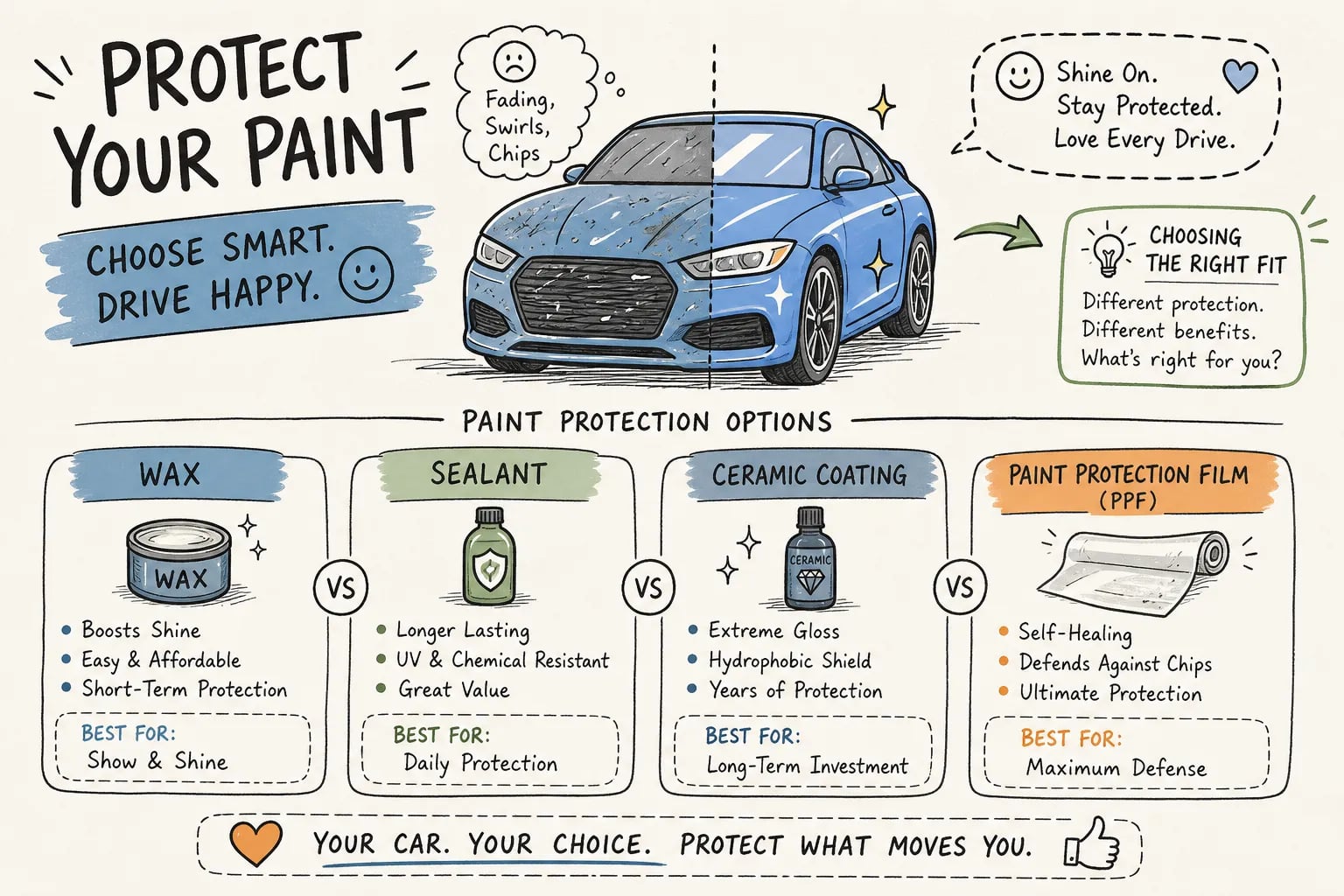
The four main paint protection options, explained simply
Most people hear “paint protection” and assume it’s all variations of the same thing. It isn’t. Each option works through a fundamentally different mechanism, which is why they perform so differently when it counts.
Paint protection film (PPF / clear bra)
PPF is a thick, flexible urethane film applied directly over your painted surfaces. It acts as a physical barrier, absorbing the impact of rock chips, road debris, and minor abrasions before they ever reach your paint. Premium versions are self-healing, light surface scratches disappear on their own with heat from the sun or a pass of warm water. Leading brands such as XPEL, SunTek, and LLumar offer warranties commonly ranging from five to ten years, with premium-tier films and careful maintenance pushing real-world lifespans toward ten to twelve years in practice.
Ceramic coating
Ceramic coating is a liquid polymer that chemically bonds to your clear coat and cures into a hard, hydrophobic shell. It does not stop rock chips, but it excels at repelling water, bird droppings, UV rays, tree sap, and environmental contaminants. Professional-grade coatings also deepen gloss and make the surface noticeably easier to keep clean, since water beads off and carries surface dirt with it.
Car wax
Carnauba wax is the classic entry-level option. It sits on top of the paint rather than bonding to it, which gives you basic UV and water resistance for a few weeks before it wears off. It requires consistent reapplication and won’t stop chips, but it costs almost nothing and works fine for what it is.
Paint sealants
Sealants are synthetic polymer products that outperform wax in durability and UV defense. A quality sealant bonds more firmly to the clear coat and typically lasts four to six months, compared to six to eight weeks for wax. Some professional-grade sealants also work as a base layer compatible with ceramic coating products, making them a practical intermediate step, and a useful component in a broader paint protection kit if you’re building up your protection routine in stages.
PPF vs. ceramic coating: where each one wins
If you’re choosing between these two, the decision usually comes down to one question: are you more worried about physical damage or environmental contamination?
Physical protection: PPF is in a different league
Nothing stops rock chips and road rash like paint protection film. The urethane absorbs the impact so your paint doesn’t have to. Ceramic coating, despite its hardness, does not prevent a rock chip, it will scratch and chip just like unprotected paint if hit hard enough. If your daily commute involves freeway miles, gravel roads, or construction-heavy corridors, PPF on the front end of your vehicle is worth serious consideration.
Environmental defense: ceramic coating is the cleaner choice
Ceramic coating wins decisively when it comes to water spots, bird droppings, tree sap, UV oxidation, and brake dust accumulation. The hydrophobic surface causes water to bead and roll off, carrying contaminants with it before they have a chance to bond or etch. PPF offers some environmental resistance, but ceramic coating is purpose-built for this category and delivers better gloss and surface cleanliness over time.
Why many owners use both together
Combining PPF on high-impact zones, hood, front bumper, mirrors, fender edges, with a ceramic coating applied over the entire car gives you the best of both worlds. You get physical impact resistance where your car takes the most punishment, and chemical defense plus enhanced gloss everywhere else. Certified installers increasingly offer this combination as a single package, typically in the $3,000, $8,000 range depending on vehicle size and coverage area.
When wax and paint sealants still make sense
Wax and sealants get dismissed in most modern paint protection conversations, but they still have a legitimate place depending on your budget and vehicle.
The honest case for wax
If you drive an older vehicle with high mileage that parks outside year-round, spending $5,000 on PPF is not a logical investment. A good carnauba or synthetic wax applied every six to eight weeks gives your paint basic UV and moisture protection for under $50. It requires consistency, but it works for what it is. Just don’t expect it to stop chips or survive more than a few weeks before it needs refreshing.
Paint sealants as the practical middle ground
Sealants offer a meaningful upgrade over wax without the cost of ceramic coating. A single application bonds firmly to the clear coat, holds up well against UV exposure and repeated washing, and lasts four to six months before it needs refreshing. For a vehicle owner who wants something more durable than wax but isn’t ready to commit to a professional coating, a quality sealant is a rational choice, and several professional-grade formulas are designed to work as a primer layer beneath ceramic products if you decide to upgrade later.
Paint protection costs and expected lifespan, broken down
Paint protection decisions almost always come back to budget. Here’s what you’re actually looking at across the four options, based on typical U.S. market pricing.
- Full-body PPF on a typical sedan: $5,000, $8,000, with larger or luxury vehicles pushing past $10,000
- Partial PPF (front bumper, hood, mirrors): $1,000, $2,000, a practical entry point for the highest-risk zones
- Professional ceramic coating: $1,000, $2,500 depending on product tier and vehicle size
- PPF combined with ceramic coating: $3,000, $8,000 total for the full-coverage package
- Wax and paint sealants: $30, $150 DIY, or $100, $300 for professional application (approximate estimates based on typical U.S. retail and service pricing)
On lifespan, PPF warranties typically run five to ten years, with premium films reaching ten to twelve years when properly maintained. Professional ceramic coatings from a qualified installer usually last two to five years, though top-tier products with regular upkeep can extend that further. In San Diego specifically, coastal salt air and intense UV exposure shorten these lifespans slightly compared to inland or shaded environments, which makes maintenance habits more important, not less. Wax lasts six to eight weeks; sealants deliver four to six months.
Matching the right protection to your car and lifestyle
The best paint protection is the one that fits how you actually use your vehicle, not the most impressive option on paper.
Daily drivers and high-mileage commuters
If your car racks up significant miles on freeways or rough roads, partial PPF on the front end paired with a ceramic coating over the full vehicle is the most practical combination. It covers your highest-risk zones without requiring a full-body film installation, and the ceramic coating keeps the rest of the car protected and easy to maintain.
Luxury, exotic, and Tesla owners
High-value vehicles benefit most from full-body PPF or, at minimum, a professional ceramic coating applied early. Tesla factory paint is notably soft and thin compared to many other manufacturers, which leaves it more vulnerable to chips and swirl marks from normal washing and highway driving. The cost of protection applied at purchase is a fraction of what paint correction or a partial respray costs later on. Acting early is the smarter financial move.
Older vehicles and tight budgets
A vehicle with 80,000 miles and a faded clear coat doesn’t need a $7,000 protection install. A professional paint sealant or a well-maintained wax routine will protect what’s left of the finish without over-investing in an older asset. The right protection decision is always proportional to the vehicle’s value and your long-term plans for it.
Simple maintenance habits that make your protection last
Even the best paint protection film or ceramic coating degrades faster without the right care routine. The good news is that it isn’t complicated once you know the basics.
Weekly wash habits that protect the finish
Use a pH-neutral car shampoo, a microfiber wash mitt, and the two-bucket method to avoid dragging contaminants across the surface. Always rinse the car first and wash in straight-line motions rather than circles. Dry with a clean microfiber towel or a forced-air dryer, never rub the surface. Avoid washing in direct sunlight, and rinse off bird droppings, sap, or bug splatter within 24 hours before they have time to etch into the coating or film.
Monthly and seasonal upkeep
Apply a ceramic maintenance spray or silica booster monthly to refresh the hydrophobic behavior of your coating and keep the surface slick. Every three to six months, do a light iron decontamination treatment to pull brake dust and road fallout out of the surface before it bonds harder. For PPF specifically, inspect the edges around your bumper, mirrors, and door handles for any lifting or dirt intrusion, and avoid pressure washing those edges at close range, the force can work under the film and lift the adhesive.
Choosing the right protection starts with the right installer
Paint protection is not a one-size-fits-all decision, and the installer’s experience matters as much as the product itself. PPF is the right call when physical damage from chips and road debris is your primary concern. Ceramic coating wins when you want environmental defense, enhanced gloss, and a low-maintenance surface. Wax and sealants make sense when you’re working with a tight budget or a vehicle that doesn’t justify a larger investment. And for the best long-term result, combining PPF on impact zones with a ceramic coating over the entire car covers nearly every threat your paint faces.
The key is knowing what you’re protecting, what you’re protecting it from, and what you can realistically maintain. Once those factors are clear, the right protection option becomes obvious. That’s where local expertise matters. If you’re in San Diego and want professional paint protection services without the hassle of dropping your vehicle at a shop, the team at Auto Detail Now brings mobile ceramic coating, paint correction, and full detailing services directly to your driveway or workplace. Contact them directly to confirm service availability, mobile options, and warranty terms for your specific vehicle. No guesswork, just the right protection, done right.
Frequently asked questions about paint protection
Is PPF worth it?
For most drivers with newer or higher-value vehicles, yes. Partial PPF on high-impact zones, the front bumper, hood, and mirrors, costs $1,000, $2,000 and prevents damage that typically runs far more to repair. If you drive frequently on freeways or roads with loose gravel, the math usually favors protection.
Can I apply paint protection film myself?
Pre-cut paint protection kits are available for DIY installation, but professional application is strongly recommended for film. Improper installation leads to bubbles, lifting edges, and adhesive failures that void manufacturer warranties. Ceramic coatings have more accessible DIY options, though professional-grade products still deliver significantly better durability and bonding.
How long does ceramic coating last in San Diego?
Professional ceramic coatings typically last two to five years. In San Diego, coastal UV intensity and salt air can shorten that slightly, so consistent maintenance, monthly silica booster sprays and semi-annual decontamination, is especially important for maximizing longevity.
Can ceramic coating go over PPF?
Yes, and this is actually the most common combined approach. Ceramic coating applied over PPF adds hydrophobic performance and gloss on top of the film’s physical protection, and it makes the film easier to clean and maintain over its lifespan.
What’s the difference between a paint sealant and ceramic coating?
Both are synthetic polymer-based protectants, but ceramic coating chemically bonds to the clear coat and lasts years rather than months. A sealant sits closer to the surface and typically needs reapplication every four to six months. Sealants are a solid choice for budget-conscious owners or as a stepping stone before committing to a professional coating.

Keeping your paint protected can make a big difference! This is a useful resource for learning more about paint protection and keeping your vehicle looking its best.